The Giving Infrastructure Fund is a startup collaborative fund that was initiated in 2024 to build the financial resilience of racial equity organisations with the power of everyday givers. The fund believes that investing in everyday giving infrastructure enables organisations to secure support from everyday givers, therefore creating more financial resilience, ensuring longevity and organisational health. The Giving Infrastructure Fund is fiscally sponsored by Moore Impact, a Black-founded, woman-led 501c3 public charity.
Principle
…We operate on the hypothesis that investing in giving infrastructure enables organisations to secure support from everyday givers, therefore creating more financial resilience in organisations, and ensuring that they’re here for the long term.
Adriana Rocha, Executive Director, Giving Infrastructure Fund
This case study describes how the Giving Infrastructure Fund (USA) responded to the financial insecurity facing racial equity organisations in the United States—particularly in the US South—by rethinking how philanthropy operates. The Fund invests in the systems that enable organisations to raise support from everyday people in their communities. The approach is intended to support a shift away from chronic financial uncertainty toward greater stability, flexibility, and long-term resilience. By strengthening everyday giving—support from individuals who give small to moderate amounts each year—the Fund’s grantee partners show the potential of community-backed funding to help position grassroots organisations to survive and grow stronger over time.
About The Giving Infrastructure Fund
The Giving Infrastructure Fund is a startup collaborative fund that was initiated in 2024 to build the financial resilience of racial equity organisations with the power of everyday givers. The fund believes that investing in everyday giving infrastructure enables organisations to secure support from everyday givers, therefore creating more financial resilience, ensuring longevity and organisational health. The Giving Infrastructure Fund is fiscally sponsored by Moore Impact, a Black-founded, woman-led 501c3 public charity.
What was the challenge?
In the United States (US), racial equity organisations are largely under-resourced, and operating in an increasingly restrictive social, political, and economic environment. Grassroots-level groups focusing on racial and gender equity and justice are some of the most vulnerable when institutional funding priorities change, finding themselves in precarious positions where they can be subject to censorship, political repression, and divestment.
In the US, the Southern region is particularly vulnerable, chronically underfunded by philanthropy, and affected by historically oppressive infrastructures that disenfranchise Black indigenous and rural populations of colour, and inhibit their basic access to social welfare.
Everyday giving — individual giving between $1 and $10,000 per year — is often a lifeline for these organisations that have built trusting networks with their communities of givers over time. However, support for improving and building everyday giving infrastructures into sustainable income sources for grassroots organisations is rare amongst institutional philanthropies. Often, they are not convinced of the importance of everyday giving, since the funds come from dispersed sources, and the infrastructure needed for collecting support and interfacing with givers is significant.
What was the response?
The Giving Infrastructure Fund, initiated in 2024, operates with the core belief that everyday givers are of utmost importance to the philanthropic ecosystem. In the US, financial support from everyday givers collectively accounts for billions of dollars annually. This group of donors is more accessible than high-net-worth individuals, and they recognise their small and big acts of giving as expressions of meaningful solidarity, often within their own communities. Because of this, the gifts of these donors are often also flexible/ unrestricted, contributing to the general support and operation of organisations, without reporting requirements or bureaucratic strings attached. These givers are often core to grassroots organisations’ identities, whose work has historically been powered, infused, informed and kept alive by this community. Everyday giving arrives with a sense of accountability and mutual care, where a community itself is often resourcing care towards its own growth. Digital infrastructures for everyday giving can also connect individuals with groups they may not have known about, enabling organisations to build community engagement and resilience, as they are able to make autonomous decisions about how best to use these resources.
Program Design and Funding Model
The Giving Infrastructure Fund’s program was designed as an innovation in the sector to harness the power of everyday giving to build resilience in racial equity organisations. Through institutional funding, the Fund supports organisations either located in the southern region of the US, or organisations working with groups in that region. Selected organisations receive both a $400,000 general support grant over a period of two years, and a capacity building grant ($25,000 in 2025, and $40,000 in 2026), intended to build their everyday giving infrastructure, with the view of building financial resilience. In practice, this could look like partners re-structuring their everyday giving program staff, improving their databases, increasing the organisation’s safety and security, tracking habits and practices of donors, among other operational improvements.
Governance, Partnerships, and Grantmaking
As the concept for the Fund evolved, Moore Impact emerged as a natural partner. Their equity-focused expertise and investments in underfunded BIPOC (Black, Indigenous, and People of Colour) communities align with our aims. With a trust-based, nimble, risk-tolerant approach, Moore Impact advances innovative infrastructure for everyday giving, an essential yet undervalued part of the sector. Moore now provides financial and grants management and helps bring new resources to the Fund. The Fund then brought on a part-time Executive Director in May of 2024, Adriana Rocha, to help design the Fund, who later became the full-time Executive Director in August, followed soon by an Assistant Director, Courtney Banayad. A Design and Grantmaking Committee — constituting six experts in the fields of philanthropy with significant experience raising money from everyday donors in support of racial justice work, was then deployed in August to help strategise and design the grantmaking process.
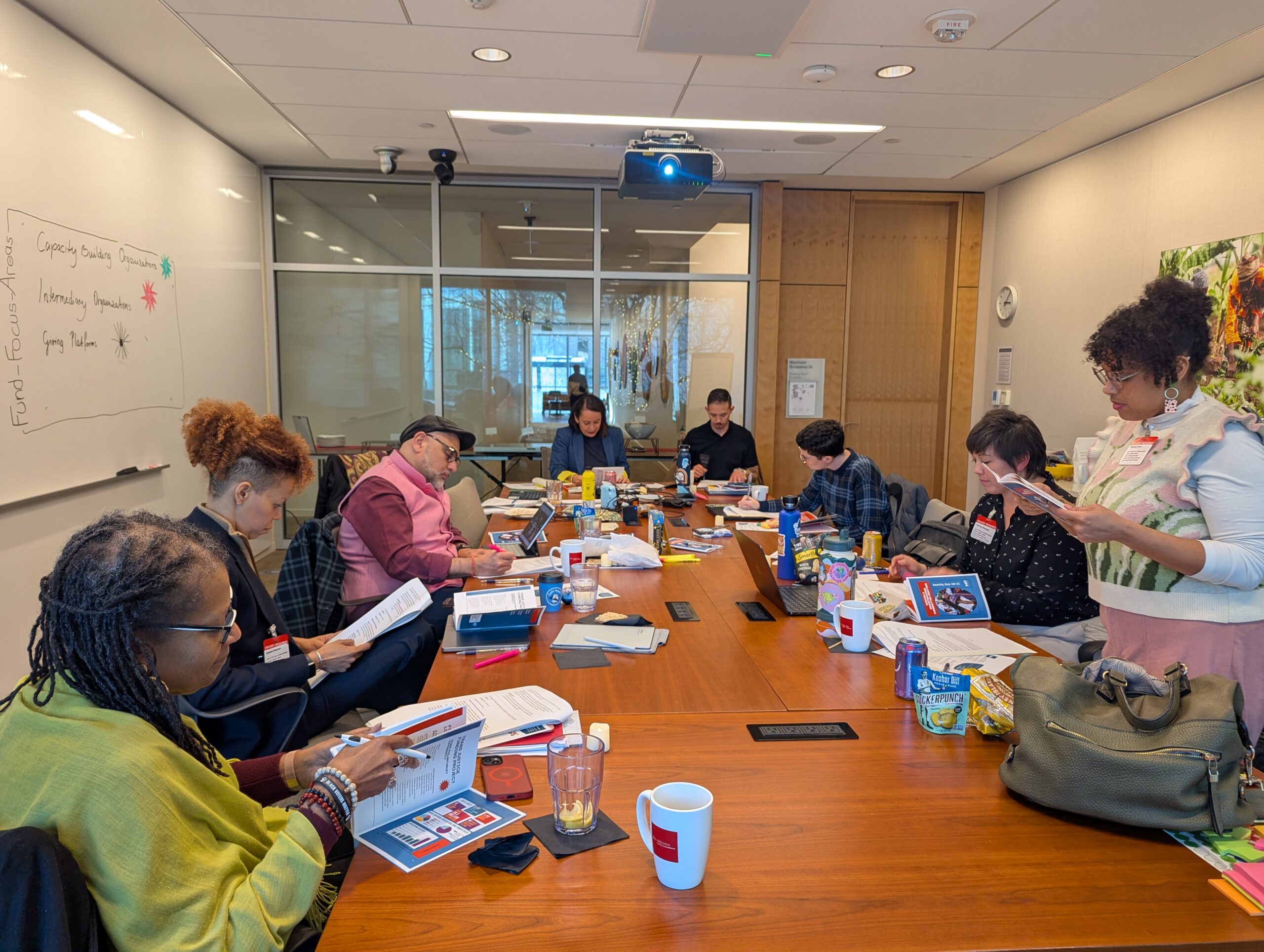
Through the Committee’s expertise, the overall purpose of the Fund — to support the financial resilience of racial equity organisations in or supporting the South through a grant for both core support and capacity strengthening of everyday giving infrastructures — was mapped out, and criteria for their grantmaking were designed. The criteria for the inaugural group of grantee partners include organisations that have an everyday giving program in place, organisations that are either an intermediary grantmaker, a capacity building organisation, or a giving platform, and organisations that are doing racial equity work. The selection process was accelerated in order to get the money to the grassroots as quickly as possible, and took place between December 2024 and February 2025, involving due diligence checks of the organisations, virtual site visits, and in-person meetings with most of the Committee’s selection before settling on the final cohort of eight partners. By strengthening organisations that already have large giving networks and are providing support to many grassroots organisations within the thematic scope of racial equity, the Giving Infrastructure Fund is able to have an outsized impact, building everyday giving resilience at key sites.
Included in their initial cohort of eight partners (to be increased to ten in 2026), is the Third Wave Fund, who published a 2024 report showing that 51,6% of their funds were raised by individual donors, and the Trans Justice Funding Project, who report that the majority of their funds are raised from individuals. The Giving Infrastructure Fund’s mandate — providing grants that are unrestricted, and focusing on the importance of everyday givers — is rooted in the experience of its directors, the expertise of its Design and Grantmaking Committee, and importantly, an understanding of how grassroots organisations more often mobilise support within their own communities.
The $400,000 unrestricted grants are aimed at resourcing organisations that are aligned with The Giving Infrastructure Fund’s ultimate mission to build financial resilience in their partners. Partners largely have significant influence and their own networks of everyday giving, allowing the Fund to effect change in giving culture, and support organisational longevity, while also advocating the importance of support for everyday giving to institutional funders.
Learning, Advocacy, and Ongoing Development
While the Gates Foundation provided the start-up seed money, the challenge now is continuing the work to bring more funders to support and invest in individual giving as a strategy. In 2025-2027, they aim to raise a further $4 million. Convincing institutional funders aligned with this approach remains a challenge. Traditional institutional philanthropy — large grants attached to institutional mandates — is a world away from the dispersed, often online networks of everyday givers, whose facilitation does require strong social, informational, financial infrastructures to collect funds and disperse information, including shows of appreciation, and other forms of regular communication that keep givers in the know. The reality is that both kinds of funds are important, and diversified income streams help to strengthen resilience and absorb shocks. Not only are large-amount operational grants crucial to sustain important work, but everyday giving provides resilient dollars and committed communities to these grassroots organisations.
Convincing funders of the importance of everyday givers is not only crucial to the Giving Infrastructure Fund’s work, but to the sector at large, as a crucial transformative step toward a more democratic philanthropy, and the support of initiatives recognised by the public as creating social impact. In doing this advocacy work, the Giving Infrastructure Fund is coming up with various strategies to talk about the value of everyday giving, and its core importance to grassroots organisations. In order to address this challenge, they are developing a webinar series and case study project based on the hypothesis that more people will be able to understand the power of everyday giving by sharing powerful stories of organisations that already have these mechanisms in place.
Grantmaking Practice and Implementation
At the grantmaking level, the Giving Infrastructure Fund operates with unrestricted funding and by keeping bureaucracy to a minimum for its partners. Understanding the ways that these organisations have been historically underfunded and overworked, instead of overburdening them with further reporting work, the Fund takes on all administrative ‘homework’. They do not require either written proposals or reports, and themselves conduct the due diligence processes, identifying partners who align with their mission, and conducting brief meetings with them to make sure they are on the same page. Having accelerated their selection process in the first round to get the money to the grassroots as quickly as possible, the Fund learned that they may be able to do more extensive background pre-vetting processes before engaging organisations in future. Being careful to apply the nuances of their selection criteria earlier on in the process ultimately lessens burdens on organisations, avoiding unnecessary site-visits or shortlist processes.
In support of their partners’ work beyond grantmaking, the Fund hosts peer learning sessions in which partners can share learnings and challenges amongst each other. Planned visits with grantee partners in the grant’s second year will also engage learning and reflection conversations to understand how grantees are experiencing these grants and their intentions of equitability and unrestricted giving.
Having a learning and evaluation approach to their work generally, the Fund partners with jdc Partnerships, who provide insights and new frameworks for evaluating philanthropy. The partnership with jdc, grounded in a longer relationship with the Fund’s director, has helped them to co-create learning and evaluation tools that guide the work, from helping them to create a theory of change, to mapping out the application possibilities of learnings from grantee partners, and finding ways to measure the impact of unrestricted grants, which help strengthen organisations, even if there are no specific project outputs.
As part of their commitment to strengthen support in the South, the Fund became a member of Grantmakers for Southern Progress (GSP), who are a network of member funders and practitioners working towards structural change in the US South. GSP is also invested in changing cultures of extractive philanthropy, connecting funders with grassroots organisers, working towards capacity building of organisations, emphasising the importance of building Black-led, women-led, queer and trans work, and creating ecosystemic change.
The Giving Infrastructure Fund is an example of a brand-new initiative that is applying mindset shifts and principles in the DNA of their construct and practice, with its focused emphasis on the collective power of everyday giving, presenting an important approach for contemporary philanthropy. While they continue to grapple with the challenge of advocacy and support for everyday giving, their grantmaking approach works to build more financially resilient organisations that are effecting significant change in the south of the United States.
What have they learned?
Trust at all levels enables effective philanthropy. The Giving Infrastructure Fund operates on three core principles: Abundance, and the belief that there are ample resources and funds should operate from a mindset of possibility; Liberation, and the support for communities to self-determine and thrive; and Community through collaboration, and bringing care and joy to their relationships. Through these three guiding principles, philanthropy is oriented toward an ethic of trust. This has enabled quick and efficient initiation of the work, and quick release of the resources from the fiscal sponsor, with the Fund having taken off speedily. Trust at the partner level means that unrestricted grants have cut out partners’ administrative labour, and emphasised the importance of them continuing with their work, with the Giving Infrastructure Fund covering the necessary bases, and working towards equitable systems of evaluation.
Build support for everyday giving amongst different actors in the ecosystem. The Giving Infrastructure Fund recognises the importance of participation at all different levels, from institutional funders, individual donors, intermediary organisations, and grassroots groups, to ultimately build everyday giving infrastructures. By offering funding, the means to strengthen organisations’ giving infrastructures, as well as partnering with intermediaries and advocates for structural change-based philanthropy, the Fund’s intervention is diverse and promotes ecosystemic change.
Build learning feedback loops into all your processes. The Giving Infrastructure Fund has an in-built feedback mechanism to get feedback from the Design and Grantmaking Committee regarding the progress of their process and ideas for changing the process in future. Alongside their partners at JDC Partnerships, they are finding ways to implement those learnings into the next rounds of grantmaking.
Use narrative and storytelling for effective advocacy. Organisations have often given the feedback that they need to be able to communicate the power of their work in order to increase everyday giving, with capacity-building grants sometimes put to use with this in mind. Storytelling has also been identified by the Giving Infrastructure Fund as key in advocating on behalf of their partners’ work to institutional funders.
Key outcomes and impact indicators
Initial Capitalisation
The Giving Infrastructure Fund was founded with an initial seed fund of $4.5 million from the Gates Foundation and fiscal sponsorship from Moore Impact.
Regional Equity Investment
They have awarded eight racial equity organisations in the US with two-year operating grants of $400,000 dollars annually. Three of these groups are based in the Southern region of the US and future grantee partners will also be based in the US South.
Infrastructure Scaling
Their additional capacity-building grants of $25,000 in 2025 and $40,000 in 2026 are geared at strengthening the organisations’ everyday giving infrastructures.
Knowledge Sharing
The Giving Infrastructure Fund is launching a case study project in 2026 to share everyday giving strategies and stories of success from their grantee partners. The first stories will be released in June and will be available at https://givinginfrastructure.com/