The H&M Foundation was established and privately funded by the Stefan Persson Family in 2013 in Sweden as an independent entity from the H&M Group. Through grant-making, resource-sharing, strategic partnerships, and harnessing its influence in the sector, the foundation works towards systems change in the textile and fashion industry.
Principle
We see an opportunity to work on the social dimensions of decarbonisation to ensure a just transition… We come in with that holistic approach, with a very strong ambition to work on a systems change level. We don’t want to just look at specific parts of problems, but instead look at the big picture.
Maria Bystedt, Programme Director of Collective Action, H&M Foundation
The H&M Foundation was established and privately funded by the Stefan Persson Family in 2013 in Sweden as an independent entity from the H&M Group. Through grant-making, resource-sharing, strategic partnerships, and harnessing its influence in the sector, the foundation works towards systems change in the textile and fashion industry. They support global decarbonisation efforts, seeking to halve the textile and fashion industry’s greenhouse gas emissions every decade until 2050, while also avoiding ‘carbon tunnel vision’ by ensuring that the transition to a net-zero future benefits both people and the planet. They work within four solution areas: Innovation, Research and Demonstration, Collective Action, and Climate Narratives. In addition to these, they also work with disaster management as a complementary area of impact – supporting vulnerable communities affected by climate-related disasters. Their well-renowned innovation challenge, the Global Change Award, supports changemakers at the early stages of their innovations in this space, facilitating scalable solutions for decarbonising the industry
What was the challenge?
Having begun in 2013, the H&M Foundation originally offered traditional grantmaking across four thematic areas: Education, Clean Water, Strengthening Women (Equality), and Planet (Saving Natural Resources / Environment). While the programmes were delivering strong and clear results, the foundation could clearly see that their funds and initiatives were perpetuating siloed interventions and isolated impact by being tied to specific focus areas. An internal strategy renewal was initiated in 2018, which resulted in the H&M Foundation changing its approach to reflect the importance of systems change interventions. The foundation deprioritised specific thematic focus areas in favour of projects that aligned with their more holistic, systems-view approach.
As a next step in 2022, they assessed where their strengths could have the biggest impact, more effectively leveraging their DNA and proximity to the fashion and textile industry. They were exploring how to best mobilise all the resources and assets they had — financial and non-financial — focusing on that specific sector, while still pushing for systems change (in line with the six conditions of the systems change model, addressing structural, relational, and transformative change).
What was the response?
The team conducted a year of research, reading, internal meetings, and expert consultations, ultimately aiming to learn from previous strategic decisions and to ground new aspects of their work in science. Given the urgency of the climate crisis and insights from the fashion and textile industry, they decided to focus their mission on supporting the textile industry in halving its greenhouse gas emissions every decade by 2050, while also promoting a just transition for both people and planet.
The updated mission rests on frameworks like the Carbon Law and the Earth for All: A Survival Guide for Humanity, a scientific framework and report to the Club of Rome in 2022, authored by climate scientists and social scientists, arguing that working on climate and equity simultaneously is absolutely necessary. This big-picture approach resonated with how the team was thinking about the decarbonisation of the fashion industry, and the systems-change perspective they had been operating with for some time.
The systems change approach used by the H&M Foundation draws on models such as the inverted triangle, which describes the six conditions of systems change. This model analyses the various factors requiring addressing if an issue is to change on a systemic level. It looks at the ‘explicit’ factors of Structural Change, like policies, the ‘semi-explicit’ factors regarding Relational Change, like power dynamics, and the ‘implicit’ factors for Transformative Change, including shifting ‘mental models’.
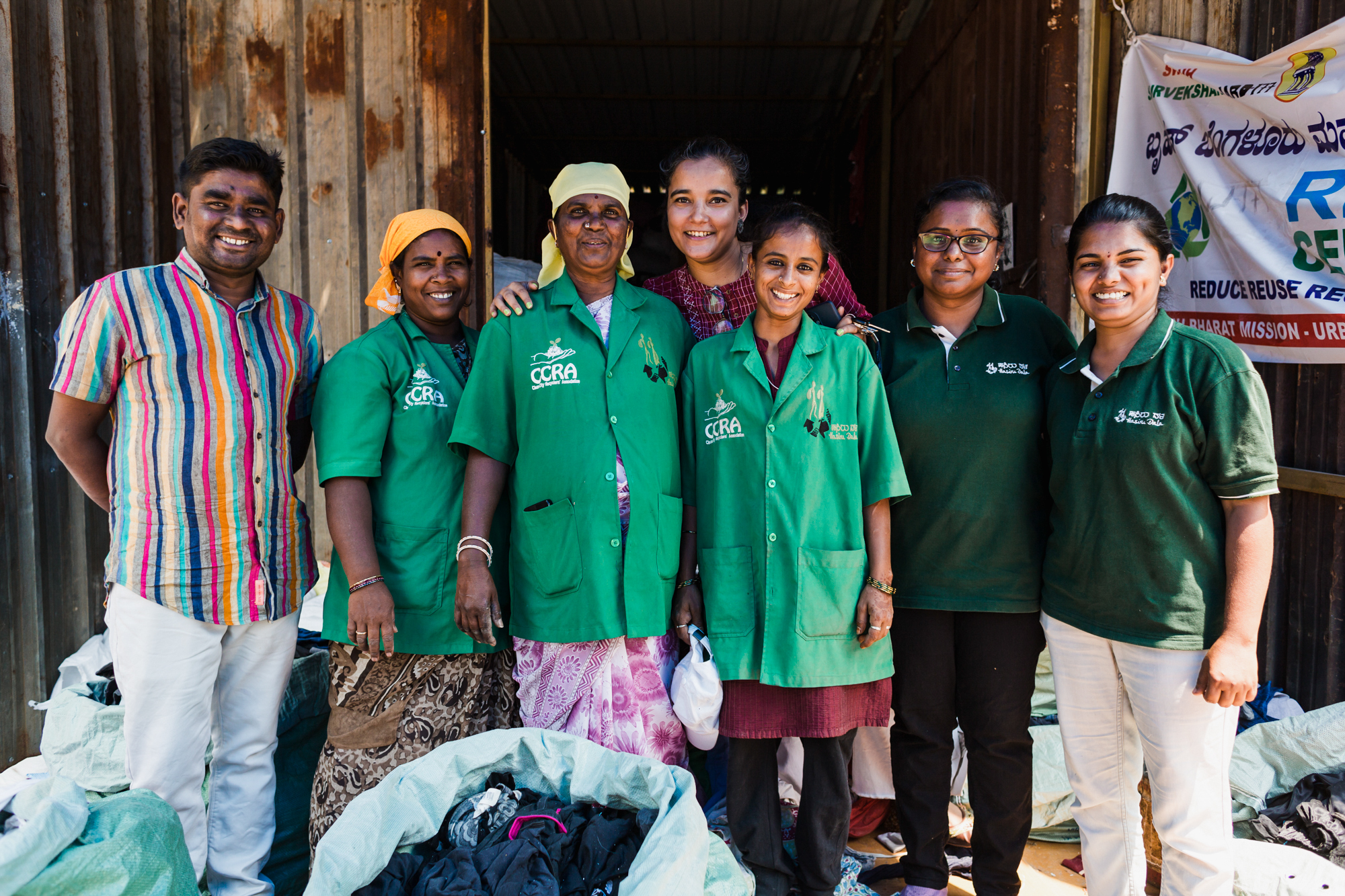
Using this model had previously led them to engage in new projects and challenges, which necessitated collaboration in order to lead to the systems change they worked for. After the strategy renewal of 2018, in 2019, they designed a project to fund a major multi-actor initiative, Saamuhika Shakti, a network of organisations that supports informal waste pickers in Bengaluru, India, to live with dignity and security. The initiative, focusing on root causes of poverty and exclusion, is an example of how the foundation understands systems change, involving organisations operating at numerous focus levels around the waste-picking profession, from education to skilling and gender.
On the one hand, the work of Saamuhika Shakti is aimed at creating circular, inclusive value chains that recognise waste as value, reduce climate harm, and offer dignified employment to a vulnerable population. On the other hand, the initiative works to address the root causes of poverty and marginalisation in India, providing access to social services, education, water, and sanitation, prioritising dignity and safe working conditions, and offering options to leave the waste picking profession through access to skilling. Within the initiative, H&M Foundation partnered with BBC Media Action to put together perception change campaigns (#Invaluables) in an effort to shift public attitude towards the waste-picking community, who are marginalised and neglected, and yet also harassed by society, seen to be at ‘the bottom’ of the social pyramid. The campaign amplified how informal waste pickers define and demonstrate their own innovation, skill, and essential role in the community, supporting a shift in how their work is recognised—from “invisible” to “invaluable”. In working towards systems change, this piece of the puzzle is crucial in shifting public ‘mental models’, and intervening in the implicit obstructions to systems change.
Based on their strategy to focus on systems change, they designed the initiative based on a highly structured collaboration methodology called ‘Collective Impact’. This methodology brings multiple collaborators together, and organises initiatives through five pillars: Common Agenda, Shared Measurement Systems, Mutually Reinforcing Activities, Continuous Communication, and, significantly, independent Backbone Support. The first four pillars require extensive meetings, talking, consensus-building, and internal capacity building, while the last pillar, backbone support, requires collective impact strategy initiatives to have an independent organisation that provides infrastructure to the work. Resources are directed to the backbone support initiative, who use a gender and equity lens in overseeing the project and structuring the collaborations that bring together actors addressing issues from access to education to clean water and sanitation, social security, domestic violence, sustainable solutions like circular models for textile waste management, and so on.
This approach represented a major change in how the H&M Foundation was working as a philanthropic donor more generally, and the change demanded a significant mindset shift towards funding in a way that meant taking risks and relinquishing power.
Even as mindsets began to shift, Phase 1 of Saamuhika Shakti (January 2020–December 2023) posed a number of challenges. The collaboration unfolded during the COVID-19 pandemic and brought together nine implementing organisations with diverse skills and thematic priorities, many of whom were working with the collective impact methodology for the first time. Since partner proposals were developed independently rather than jointly, some challenges surfaced during implementation, including overlaps and gaps in the selection of communities and households for interventions. As a result, organisations often spread their efforts across different localities, with thematic interventions—such as housing or skilling—being implemented in isolation rather than converging on the same households, thereby diluting the ambition of delivering multiple, coordinated services. Despite these constraints, Phase 1 saw meaningful progress in building trust, both within the informal waste-picker community in Bengaluru and among the partner organisations themselves, laying an important foundation for deeper collaboration subsequently.
The many challenges of Phase 1 meant that Phase 2 had the opportunity to iterate and implement learnings. The team realised that co-creation of the initiative needed to happen at all levels from the very beginning: organisations sat together and hashed out the pillars, figuring out how, together, they might operate towards holistic change for the community they supported. Examples of changes that have been made include the creation of a shared resource centre in Bengaluru, as well as the development of collaborative KPIs that help each partner continually measure how the collaboration is working for them. Planning concrete collaborative activities unlocked cooperation on a larger scale, and the initiative now sees significantly more organic collaboration beyond planned activities (shifting from roughly a 70/30 planned–organic split to closer to 50/50).
The team learned that building this kind of complex collaboration takes time, resources, and the courage to face challenges head-on, but that it is ultimately worth the risk. In supporting Saamuhika Shakti, the H&M Foundation also sought ways to strengthen the initiative’s sustainability beyond the development impact driven by the civil society sector by encouraging private sector engagement and market-based solutions. By creating a base of social security and dignity for waste pickers, the initiative was able to demonstrate how inclusive circular models can work in practice.
One example is the connection made with the social enterprise Hasiru Dala Innovations (HDI), which purchases plastic waste from individual waste pickers under fair conditions and is World Fair Trade certified. Through such facilitation, HDI has gone on to establish a business relationship with a global retailer and today serves as their preferred supplier of recycled plastic in India. The foundation’s role was to enable these kinds of strategic connections that contribute to systems change approaches for decarbonisation in the textile industry, and then step back to allow collaborations to develop independently. Such linkages illustrate how inclusive systems can address both environmental and social challenges, while also reducing the precarity of philanthropy by embedding long-term sustainability into market structures.
Working with systems change is no easy path, and it has also required a lot of internal work at the H&M Foundation to make space for open conversation, do collective research with significant adjustments to the team’s mindsets, and shifts in major aspects of the way that things are done at the foundation. One significant shift is the way that the H&M Foundation’s Global Change Award is run. First of all, it has shifted from a purely innovation-driven award for ‘disrupters’ of the industry, to one that is centred around systems change. It has also shifted to emphasise the work of early-stage innovations, with a greater focus on the Global South, and a wider definition of who they could support, while also more clearly taking on the role of being a super-connector and facilitator of strategic connections to drive significant change in the industry.
The H&M Foundation, having grown from 2 to 22 staff over its 12 years, still constitutes a lean team but sees its potential to contribute to an outsized impact by maintaining a ‘startup mentality’. What this means is placing more trust in partners they have elected to work with, by maintaining less oversight and allowing the experts to do the work they do, thus sustaining their mandate to take risks. It has also increasingly meant harnessing their connections in the fashion industry and social sector to facilitate private sector collaborations with sustainability potential beyond their philanthropic work, and advocating for systems change in the decarbonisation space with like-minded funders and initiatives.
The H&M Foundation is a member and donor of Catalyst Now and a signatory to their framework. They were initially inspired by their report titled, ‘Embracing Complexity: Towards a shared understanding of funding systems change’. By donating towards Catalyst Now’s work, the H&M Foundation supports players in the ecosystem who are advocating for systems change approaches to funding and shifts in power away from the Global North.
What have they learned?
Address root causes and recognise the intersectionality of social and environmental issues. Saamuhika Shakti brings together eleven organisations working in concert to change the lives of Bengaluru waste pickers. By understanding that the root causes of poverty amongst the waste picker community are systemic (including low and unstable wages, hazardous working conditions, societal discrimination, limited access to welfare services, and additional layers of vulnerability for women and girls in the community), Saamuhika Shakti involves diverse organisations addressing these issues at every level, having sustainable outcomes for people and planet.
A risk-tolerant board enables transformation. It is the founding family’s outspoken wish that the H&M Foundation should be innovative and embrace risk by testing new and not-yet-validated ideas and ways of working. A board willing to take ‘leaps of faith’ and trust its team’s propositions makes way for experiments with new approaches. The ecosystem, whose tolerance for risk is diverse, greatly benefits from those willing to pioneer new concepts, as it is able to learn from innovations, mistakes, and novel proofs of concept.
Joint action has a learning curve and needs commitment and perseverance. Collaboration is not easy in a social sector that has siloed itself according to issue-based initiatives and projects, rather than through a systems change lens. Joint action projects, like the H&M Foundation’s Saamuhika Shakti, required taking the courageous first step of attempting the application of what was a new collaboration approach for them: Collective Impact. In Phase 1, stakeholders did not manage to truly collaborate on every aspect of the project, and the benefits for the community were thus siloed. However, in Phase 2, because of this experience, implementation of collaborative structures was in place from the get-go, making the rollout of this phase much smoother.
Leveraging influence and connections as assets for impact. By keeping its initiatives relevant to the textile industry and triangulating industry challenges with social and development ones in the geography in which they work, the H&M Foundation has been able to add a layer of sustainability to its social development projects by facilitating connections to the private sector. By recognising their connections as a valuable resource, the foundation is able to create an outsized impact beyond its own budgetary limitations.
A systems change approach is iterative and requires internal mindset shifts. The H&M Foundation’s strategy refinement has evolved over the years. While its projects may have shifted, one of the major transformations was shifting the mindsets of the team internally and making sure that its own work was not still done in silos. It is just as important to transform this internal thinking in order to do effective systems change work: they embarked on this process through a year of collective reading of research in the sector, workshops, discussions, and consultations with experts.
Partnerships are relational, not transactional. Partnerships should not be approached as a transaction and should rather be engaged as relationships, collaborations, and mutually beneficial initiatives. The H&M Foundation has worked to streamline as much as possible for its partners, including processes like due diligence, agreements, and reporting – striving to make the workload lighter..
Key outcomes and impact indicators
Family Philanthropic Donations
Since 2013, the family has donated SEK 1.9 billion (approx. USD 190 million) to the H&M Foundation.
Global Change Award
The Global Change Award supports ten early-stage innovations each year to help decarbonise fashion, with the winner receiving a EUR 200,000 grant and joining the year-long GCA Changemaker Programme.
Collective Impact Results
In the 2020-2023 Phase 1 of their Collective Impact project, Saamuhika Shakti:
7,293 waste pickers and family members were trained on vocational and life skills.
5,919 people from waste-picking communities gained access to clean drinking water and sanitation facilities.
11,191 children from waste picker communities accessed quality basic education.
148,432 kg of textile waste was saved from going to landfills.